Art for Game of Thrones Winter Is Coming Portraits Artstation
Games are not art — they're amend. Information technology just depends on whom you inquire.
In that location'south this on-again, off-again argument within the intelligentsia as to whether games should be placed on the same pedestal as books, movies, music, and paintings. Just even the newest of the accustomed fine arts, movies, have had at least a century to develop.
Conventional videogames–and I'grand taking Pong, the equivalent of cave drawings, every bit my starting point hither–commenced less than 40 years agone. In that time, games have mimicked movies, electronically emulated books, and tried their hand at playing on some emotional heartstrings. The large difference is that well-nigh conventional fine art forms are passive and two-dimensional experiences: Y'all sit down in front of and soak in whatever the artist presents you with. Videogames attempt to create an interactive experience that puts the viewer/ player in control of the palette.

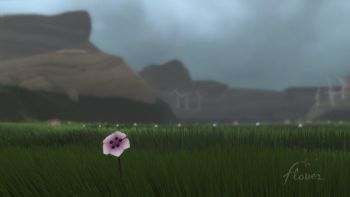
Enter Shanghai-born Xinghan "Jenova" Chen, artistic director of ThatGameCompany. Since earning his graduate degree from the University of Southern California Film School'southward Interactive Media plan, he has helped arts and crafts several simple-but-surreal game projects that practise more than than cater to a twitch response. His thesis project, Cloud, floated along, accumulating a post-obit on the indie gaming scene. Flow cast players as an ever-evolving single-celled organism–and that, no doubtfulness, inspired the first stage in Spore. The best mode to describe Chen's latest game, Flower: It's a get-go-person gardener. And it'due south well-worth the $10 asking price at Sony's PlayStation Shop.
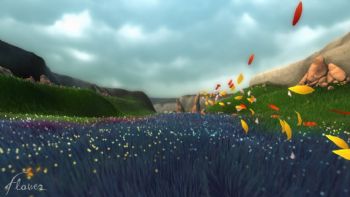
The levels, if you choose to telephone call them that, are the dreams of flowers. Yous are the wind, fulfilling bloom fantasies–yeah, it sounds kind of foreign. But just try it. This is a Zen practice with an occasional bays for completing a task. A meditation pool with an endpoint. More important, it passes my all-important "wife examination": She was entranced as she watched me play, until finally she yanked the controller out of my hand to endeavour her luck with it. The last time I got that kind of response out of her was when BioShock came out.
But back to the old "games-versus-art" argument (I'k looking at y'all, Ebert). I spent some time chatting with Chen recently about the country of gaming and how (if at all) it's maturing. Here's what nosotros came up with:
A Boy and His Bloom
PC World: How would you attempt describing Bloom to someone? Is it a game, fine art, or something else entirely?
Jenova Chen: Flower is made with a different mentality. It's a safe, warm experience. It's like a verse form or trip the light fantastic toe that uses symbolism and scenery to give the player a comforting backdrop.
PCW: And I gauge that this would make y'all the choreographer?
JC: [laughs] Yep, nosotros're non level designers. We provide all these moves, and because players are dissimilar, they will perform the moves differently. It'southward a game that is meant non merely to play, merely to scout.
PCW: A game that you watch–technically, that'd brand information technology fine art. As for the person who grabs the controls, let'south talk a petty more about the game itself.
JC: The terminate goal of the player is to brand the world a meliorate place. The role player is the consciousness of nature. You're living through the dreams of flowers sitting in pots. Gamers call them levels, just each of the dreams for the different flowers has different goals. The Rose, for example, sees a desaturated, drab globe of concrete merely wants to add together color everywhere. As you lot complete the dream of one blossom, the 2d flower sprouts and fills in a certain aspect of life. The gameplay is that y'all're this consciousness, this desire. You're bringing life into the world–not the guy killing aliens.
We idea of this similar a movie feel. You could probably cease this in two and half hours, but you actually get a lot more than out of the game after you've finished and come up back to revisit each flower's dreams. You find more to explore and play more. It will exist a good therapy–to heal yourself and reverberate on things.
PCW: How did you come up with the idea of making a game about flowers, anyhow?
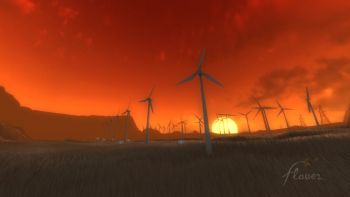
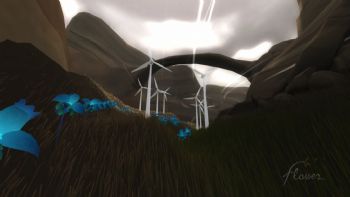
JC: I grew upwards in a city, in Shanghai. I was surrounded past skyscrapers and people. I was never surrounded by nature. When I was on my manner into Los Angeles, I saw this windmill farm. Grass fields, bluish heaven–I'd never seen these things before. Where I lived the sky was purple. And then, every bit an urban man, I was attracted to these things I hadn't really seen before. When y'all really go into nature and go hiking, you actually outset missing the metropolis and the people. So I wanted to create a space like a window from your living room, and you get surrounded past nature. Meanwhile, you however feel condom and warm. It'southward a harmony betwixt nature and urban life.
PCW: Commonly, games like this don't appear on store shelves…
JC: That's considering digital distribution allows for more than risk-taking. It allows minor development houses to take chances without having to score funding to publish the game on discs. That cost forces you to brand sacrifices forth the way. It makes yous cut costs, enforce deadlines and send a game that you might not be equally proud of. Yous only tin can't run that risk. For a game similar Flow, it only toll between 500 and 600k, not even a million. [Ed. annotation: And that'due south gone on to huge success.] Sony'southward been slap-up to piece of work with in this respect and has been very supportive both with Flow and now Flower.
Selling Games Brusque
JC: I think I'm pretty stupid to start a company. I left a pb designer chore at Maxis working on Spore to found ThatGameCompany. I was trying to observe someplace that was doing what I wanted to do. Nobody was.
PCW: What was missing?
JC: I run into entertainment as something that feeds you–like food or water, just for your emotions. Videogames used to exist a software niche…merely information technology isn't fully mature yet. The difference between a new medium and a mature medium is based upon the variety–more than just i or 2 emotions. In that location aren't merely scary books or movies. Or sad songs. Games are still largely seen as a toy and non only by the mainstream audience, but past some developers also.
PCW: Wouldn't you say, though, that these days games are getting a picayune more than sophisticated?
JC: Well, the people who accept a new applied science are the younger ones — the ones willing to accommodate. That'southward why the start games by and large catered to kids. In gild for the concern to succeed, they've needed to focus on the kids. To a degree, information technology'due south still that manner. Kids similar flashy imagery and colorful cartoons. And as they go older, they like more than competition and to be more powerful. Many games are based on this empowerment.
PCW: And I guess that feeds into the stigma still attached to games…and being a gamer.
JC: Yeah, no ane asks yous if you lot're a film watcher or if you lot're a reader, but when it always comes to games, yous're a gamer. That's because we've got a means to get. People utilise phrases similar "cool" and "fun," but seeking a more sophisticated audition ways doing more. People read a book, for instance, merely there'south this thought that they will absorb something from it. Something mentally stimulating that they volition be able to use elsewhere.
PCW: At least some games strive to do more, just I'd have to agree that at that place'southward still a lopsided focus on something like graphics.
JC: If y'all retrieve about it, most movies are divided past feelings. Games are divided by technologies–or the skills that they test. That often casts games as dismissible pastimes. Think of game pattern as a saucepan. Crytek created a cute engine and Crysis looks realistic and good. Just if the story doesn't ascent to the aforementioned level as those graphics, information technology feels like an uneven effort and things in the game spill over the sides. If the gameplay isn't as good, it doesn't experience right. Considering [ThatGameCompany] is small, we don't have the luxury to pile up i feature like, say, graphics or story and focus on the whole package. We need to keep things concise.
PCW: Curtailed is ane fashion to put information technology. Here's how your games work: Tilt the PS3'southward Sixaxis controller to move and press a unmarried button. No instructions, no tutorial, you only drib players into the world.
JC: We need to provide content outside the ruby-red zone so that adults and people that normally wouldn't think to catch a controller, would. And when they do take hold of the controller, make it elementary to understand. At first, we tried different gameplay with complex controls–even with wellness points–simply that didn't feel right for the emotions we wanted to convey. The music and ambiance combined with the visuals and controls convey more. That'south why there are no voices, no words, and no instructions.
Games, the New Movies
PCW: Since you're coming from the perspective of a USC Film School graduate, where would you say games are now compared to, say, movies?
JC: When films offset appeared, it was this brand-new medium that started as a engineering innovation. Sophisticated storytelling came later. It's easier to sell a engineering science if you evoke key feelings. If you look at some of the earliest films, like a French ane that captured a train coming through a tunnel, it scared people out of their seats. Don't games sometimes get those same reactions?
PCW: No arguments about games tapping fear and adrenaline. That, they've got downwards. Merely using that film comparing, have we at to the lowest degree made it out of the "talkies" stage?
JC: The game industry started in the '70s and has grown very quickly. The very first generation of filmmakers who grew up with films as kids–they went to universities and studied how to arts and crafts films. The George Lucases and Steven Spielbergs.
When George Lucas went to flick school, people were surprised that there actually was a school for film. Now, people are reacting that same way to game schools. In school, we studied all these mediums–storytelling, psychology…and I recall, as a upshot, when I mention some ideas to electric current game designers, they'll say, "Oh, this sounds cool, but is it fun?"
I judge my reply would exist that we're at the betoken where George Lucas and Steven Spielberg are coming out of movie school.
PCW: You heard information technology here first–THX1138 and The Duel, coming to a console near you lot shortly! Seriously, though, there is this dismissive attitude toward gamers. Practise y'all remember this next generation of designers will change people'south minds about games?
JC: People coming out of game pattern schools are now thinking about games differently than those that've come up before. We hope that games volition become more respected. In Japan, everyone reads manga–it'south a national art course. Successful businessmen and teenagers read them on the trains. In America, comic books are viewed as some nerdy activity. Why so different? The content matured at a different pace–and I don't want to come across games get lumped into that same, immature category.
PCW: Sorry for the clichéd question, but can a videogame make you weep yet? Besides if the game is besides tough, that is….
JC: There are moments in gaming where you'll sympathise with a character and maybe experience a petty sorry. Well, videogames take made people cry. Information technology'due south easy to cry if you've experienced something deep and emotional. A part-playing game in China I played made me cry–even if information technology's cliché–but as a kid, if you're exposed to something for the outset fourth dimension and conveys a story. If you lot've never read Shakespeare and someone slips Romeo and Juliet into a game, the first time you see it somewhere is jump to make you cry. The medium improves by the kids who become moved and are motivated to brand their own games.
PCW: How many times has it backfired, though? That the game gets in the way of a good story?
JC: I force myself to play some games…similar Last Fantasy XII. I had to struggle through considering of all the [endless quests]. Even though I really wanted to know how the story ended, after a couple weeks I had to just surrender. The task of making your graphic symbol gain more experience to consummate the game had no relevance to real life. And that is where a lot of games lose people.
PCW: Thanks, Jenova.
Mayhap part of the problem is that they are chosen "games." Snobs turn their nose upward and remember of Pac-Homo on the Atari 2600 or something–and instantly file it in the category of mindless diversions. Their loss. You lot got a better name for videogames? Allow me know!
Until side by side fourth dimension…
Need even more nerdity? Follow Casual Friday columnist and PC World Senior Author Darren Gladstone on gizmogladstone on Twitter for more fourth dimension-wasting tips.
Source: https://www.pcworld.com/article/533505/games_not_art.html
0 Response to "Art for Game of Thrones Winter Is Coming Portraits Artstation"
Post a Comment