According to the Reading the Success of the Godfather Can Be Treated to Coppola's
Navigating Coppola's Maze: Editing in The Godfather
By Sarah Rivka
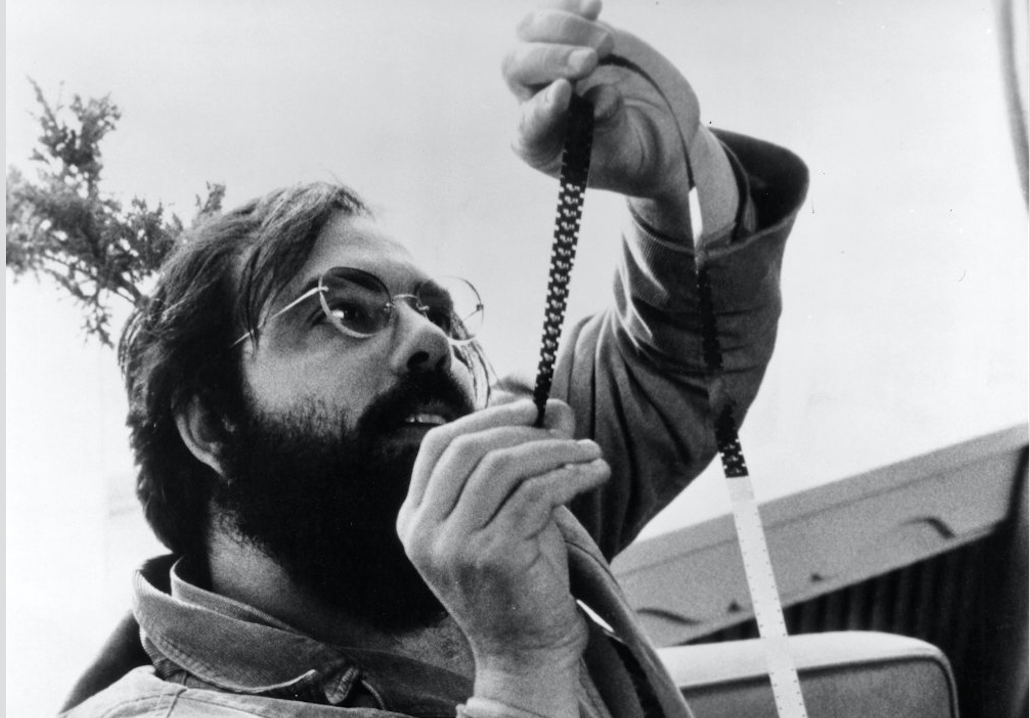
A motion-picture show is written thrice — in pre-product through screenwriting, in production through shooting, and in postal service-product through editing. Francis Ford Coppola's The Godfather was written (and re-written) in the editing room by a full of six editors, only two of whom, William Reynolds and Peter Zinner, were credited. Coppola's biggest struggle, edit-wise, was to reduce the film to a length that Paramount Studios could tum.
Co-ordinate to Harlan Lebo in The Godfather Legacy, "By the time principal photography was completed, Coppola had shot 500,000 anxiety of potentially usable footage, or more than ninety hours of fabric." Coppola repeatedly removed and replaced scenes, often to "appease the studio," resulting in the edit becoming a "maze," with multiple scenes sliced and abandoned on the cutting room floor. (Lebo 188) The work was an epic exercise in reduction that won Reynolds and Zinner a nomination for the 1973 Academy Award in Editing.
The essence of cinema is editing. It's the combination of what can be extraordinary images of people during emotional moments, or images in a general sense, put together in a kind of abracadabra.
— Francis Ford Coppola
Completing their labyrinthine edit, Coppola and his team managed to create contrasting rhythms that amplified violent scenes. Through its varying rhythmic tools—from continuous action to hard cuts and cross dissolves—The Godfather lulls the audition into submission in order to intensify the impact of violent action when it arrives. The rhythm of the motion picture'southward editing thereby mirrors the rhythm of the Corleone family unit, which strives to maintain an equilibrium but oftentimes resorts to violence in gild to reach information technology.
***
Rather than utilize a non-linear editing manner where time is out of gild (as famously done in Orson Welles's Citizen Kane and Quentin Tarantino's Lurid Fiction), The Godfather is edited in continuous action, with scenes passing in chronological order from start to finish. Coppola's use of continuous action helps create his lulling ambiance. Every bit nosotros sit in scenes for long periods of fourth dimension—scenes in which no violence occurs—we fall into the balance of the Corleone family carrying out business. Rhythmically, the majority of the pic exhibits this slow, brooding pace.
Within said rhythm, one editing tool that Reynolds and Zinner employ is the transitional cantankerous dissolve. A cross dissolve is the overlapping of two images in either ii dissimilar scenes or the same scene. In contrast to hard cuts, where there is no visual overlap, cross dissolves are a way to tiresome downwardly activeness, creating a gradual and therefore comforting effect.
This lulling and brooding ambiance causes the dispersed moments of violence to feel increasingly terrifying. When those moments of violence ascend, both the film and viewer are bombarded by a rush of adrenaline. In the gruesome scene of Woltz finding his prized horse's severed head at the human foot of his bed, for instance, we open with multiple cross dissolves over exterior shots of his home, sprinkled with the audio of morning crickets. This establishes an idyllic morning time earlier the horror. Similar to other parts of the flick, it is a calm before a storm.


After the idyllic California cross-dissolve setup, the horse's head is revealed through a long take. Jazz trumpeter Miles Davis has suggested, famously, that "[m]usic is the infinite between the notes. It'southward non the notes you play; it's the notes you don't play," and a similar principle applies to the language of film. A lack of cuts is oftentimes more powerful than countless dramatic splices. Had Reynolds and Zinner employed quick cuts here, the horrific reveal of Woltz's severed horse'south head would read as a modern-day slasher film, which Coppola specifically aimed to avert so that The Godfather would not fall "[t]oo much into the Corman Horror movie tradition." (Coppola,The Godfather Notebook)
The long have of Woltz waking upwards, discovering blood, and finding the equus caballus's head, all within the same shot, creates a sickening feeling that the audition can't escape. We are forced to feel hurting in real-time with Woltz. There are a couple of rhythmic beats resting on the head, making information technology all that much more terrifying and visceral. The shot holds on the horse's head for the first ii beats of Woltz's scream, exacerbating the visceral nature of the horse's killing. We practise not cut until afterward two screams.
While Woltz screams, we visually cutting further and further back to static shots, amplifying his sense of loss and powerlessness in this predicament. In contrast to the idyllic cross dissolves of outside shots at the opening of this scene, these hard cuts at the scene'south finish intensify the sense of discomfort.


***
Two scenes that farther underscore the potential of a long take without edit are Bonasera'south opening monologue and Connie'south confrontation with her hubby Carlo. In the opening monologue, we fade in and there is no hard cut, or any cut for that matter, for four minutes. The get-go hard cut of the film is when Marlon Brando's grapheme of Vito is revealed. Considering this is The Godfather'south primary cut, information technology signifies his prominence as a grapheme.


The scene in which Connie struggles to face Carlo also showcases the power of allowing a long take to play without editing. We follow her from the kitchen, to the dining room, to the parlor, back to the kitchen and into the hallway with the knife—and all without whatsoever cutting. In that location is no edit until after she is property the knife; at that moment we cut to her going in the bedroom. Just as when we experienced Woltz finding his equus caballus's head, we are stuck in real time with Connie, vicariously trapped in her pain. This scarcity of edits also allows the actors to fully actualize their performance, further intensifying the audition's experience.

***
No scene in The Godfather is more famous, editing-wise, than the baptism scene—the movie's bravura climax. This scene utilizes the editing technique known equally cantankerous-cutting, or parallel editing. In parallel editing, two or more scenes are woven together. These ii scenes may be occurring simultaneously or happening at various times, in a montage manner. While it is likely that the baptism and murders occur within a similar fourth dimension frame, the sense that the film may be breaking, for the first time, from its continuous action underlines this scene's importance.

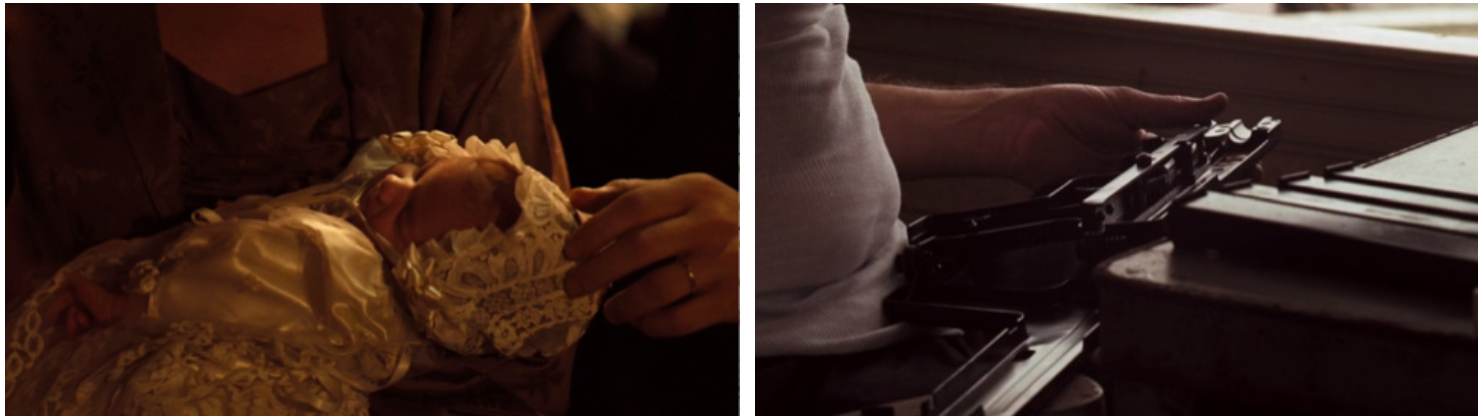
The use of parallel editing allows for stark juxtapositions—sharp contrasts in tone, and often in concept. Michael is becoming a godfather in ii senses—to his niece, and to his mafia family. We open in the church, far away and cutting closer and closer in to Connie's babe (played by Coppola's now manager-girl Sofia). The beginning cut nosotros see dramatizing this contrast takes the states from the hands of Michael and Kay, holding Connie's baby, to the hands of some other adult, property a gun. This is the first juxtaposition where the audience tin draw parallels between the two worlds in which Michael vows himself to live. Had Reynolds and Zinner edited these as separate scenes, non back-and-forth, the audition would not have the aforementioned thematic guide from the filmmakers.
We cut from the gun's preparation to Michael, whose composure illusrtates how he ruminates, coldly, on the imminent deaths. The baby meanwhile has gone from crying to a state of calmness; at that place's a boring in the editing and a pause—another at-home earlier the tempest. As the organ builds, Michael says "I practice" to renouncing Satan, his sins, and becoming godfather, of baby and mafia. The parallel pre-killing cuts quickly together and the baby is once again wailing, furthering the emotional touch on. As seen below, the first parallel cutting where he renounces Satan is followed by a murder.

We then cut back to Michael, who says "I practice renounce him." Afterwards, we are pulled into another murder. Along with the organ soundtrack, this cross-cutting creates a rhythm that punctuates each murderous beat. Between each of the following murders, at that place is at least one cut back to Michael, suggesting his responsibility for the activity carried out in his family's proper name.

***
In their maze of an edit, Coppola, Reynolds, and Zinner crafted a movie of varying rhythmic qualities, allowing it to render to an equilibrium after moments of high tension and violence. The flick'due south lulling rhythm is reflective of the residual that Michael Corleone struggles to reach for his family unit. In his mafia world, these moments of violence are inevitable—and he oft succumbs. Rather than editing these scenes into ones that glorify horror, Reynolds and Zinner made them cogent and visceral. The Corleone family, we sense, is stuck in a labyrinth of their own making, perpetually attempting to restore stability and without an exit in sight.
Sarah Rivka (Cal '19) is a junior majoring in Linguistics with a pocket-size in Artistic Writing. She recently returned to school after traveling and working as a freelance video editor. Outside of class, she spends fourth dimension at UC Berkeley'southward radio station DJing soul, jazz, rocksteady, highlife, poems, popular, and more than nether the moniker Feel Good Weird.
Works Cited
Francis Ford Coppola, The Godfather Notebook(New York: Regan Arts, 2016).
Harlan Lebo, The Godfather Legacy(New York: Simon and Schuster, 1997).
The Murder of Luca Brasi: The Curiously Moving Death of a Henchman
By Jenna Allen
The scene begins with the photographic camera positioned at a low angle, hovering merely above ground level. Nosotros are transported into a setting never before seen, one that is fashionable, well-decorated, Fine art Deco-themed, and visually intriguing. It is a mere hallway but spacious, a serial of platforms and stairs—pristine, white, heavily mirrored, gilt-accented, and possessing an opulence that plainly states "luxury."

We run into the lone effigy of Luca, whose back faces the camera, dressed in all black and ascending the stairs. His garments are dark-toned, contrasting with the surge of brightness that is the background. His looming stature fills up almost the entirety of vertical infinite from ground to ceiling, as he ascends with a casual, confident gait. He is out of place—a nighttime, solitary effigy situated amongst a landscape of brilliant white. When he reaches the top he removes his coat and, if we were unsure earlier almost the identity of the tall figure, the wide profile allows us to see him clearly now: information technology's Luca Brasi, Don Corleone'due south almost valued henchman.
The surrounding mirrors display his dark demeanor—his sober, calm professionalism—in multiple dimensions, but at that place seems to be one essential Luca. He is, indeed, a professional. He is a homo sent out on a mission—a mission by Don Corleone.
At that place is something ironic about Luca's presence here, and it is non simply his appearance. From the previous scene, nosotros already know that Luca is to prepare the bait, to feign discontent with the Corleone family, and to ultimately test the waters for this newly emerging character, Sollozzo. Luca'southward loyalty is executed in the class of a betrayal—one that is acted, of course. Thus, when Luca first steps foot into the club, with the intention to carry out the Don'south plan, a silent tension smothers the air. This is all a test.
It is a test for Sollozzo—in the most obvious sense, we desire to know if he tin can be trusted—just more so it is a examination for Luca, our principal interest in this scene. We are hither directed to run across how Luca will fare, this loyal, eagerly-obliging homo who has been thrust into the Don's dirty work. We cannot help having some stored attachment for this human, who offset endears himself to the states at the nuptials with his poorly performed cheers to the Don. Thus, when Luca dies on an errand of loyalty, nosotros register heavy tremors of shock. A sense of loss, keyed to the abuse of Sollozzo and Tattaglia, begins to colour The Godfather, often exploding upon us in the near sudden and roughshod of ways..
Though the impact of Luca's death scene has much to exercise with surprise, it also has deeper, more complex roots. Our emotional response to Luca's death hinges on what we've come to know nearly him: at this point in our feel of the motion-picture show, he is not only some brawny, disposable crony, but rather an actualized, circular character. In Puzo's novel, Luca Brasi's loyalty to Don Corleone is established through a long history of violence—murders committed on Corleone's behalf. (Annotated Godfather, 75) In the film, Brasi is a much-abbreviated version of this ruthless killer, merely he is fleshed out just enough, and with singular idiosyncrasies, to draw our attachment.
* * *
First impression-wise, it is difficult for the viewer to focus on any aspect of Brasi other than his gigantism. He possesses all the properties of a menacing assassin whose sheer majority and size instantly disembalm his raw strength. Kay echoes this notion at the wedding, remarking to Michael in a low tone, "See that scary guy over in that location?" The actor who fills this "scary guy" function is vi'6" Lenny Montana, an ex-wrestler who had been known by the moniker "The Zebra Kid" and was the World Champion at one bespeak. (Annotated Godfather, 37) Such a effigy inadvertently dwarfs all the wedding ceremony guests around him.

But the longer the camera focuses upon Brasi, the more nosotros encounter of his contrasting, almost endearing interiority. The "large scary man" who is talking to himself is really frozen in deep concentration, fumbling and repeating the same words over and over once again. He strains himself in the midst of merriment. Anybody around him is alight with joy and so there is Brasi, mumbling to himself, a heap of nerves. There is something sweetness about a man who does not match the fear he inspires—who is quickly deemed the 'scary' guy while possessing a slightly softer, grateful side inside.
The death of Brasi is much more transactional—not "strictly business," to apply a phrase from the film. It is emotionally affecting.
By suppressing Puzo's version of Brasi, who is marred by a more unforgivable by, Coppola gives us a Brasi who is known only by his loyalty. This Brasi exhausts himself with perfecting a memorized spoken communication of gratitude, and even gives money later for the bridal purse of the Don's daughter. Yep, he kills for Don Corleone, merely he also receives an invitation to an exclusive family wedding ceremony; we come up to know him purely through this bail to Don Corleone. His expiry, and then, is much more than transactional – non "strictly business," to use a phrase from the film. Information technology is emotionally affecting —the poignant outcome of his "pledge [of] never ending loyalty."
***
At the start of the scene that leads to his expiry, we already know what Luca Brasi really is. He is a made defector who must, for now, coffin his unshakable fidelity to Corleone. When he steps into this lavish place of meeting, we as viewers are thrust into a moment of waiting, a moment of pressing doubtfulness. The gilt ornamentation, the trendy aesthetics, the overall unspoiled feel—burgundy walls, gilded dim lights, everything shrouded in shadow: all these elements foster a mellow ambiance. Surely, no violence tin erupt in a identify as sedate and sophisticated equally this? And even if it does, we have faith in the reliable, tried-and-true Brasi.
When we see the figures of Bruno Tattaglia and Virgil Sollozzo inside, there is something almost them that blends into this absurd, fashionable setting. This is the Italian-American Mafia—sleek entrepreneurs, cleverly veiled criminals—and this is where they meet, every bit businesspeople accepted to a tableau of luxury. Tattaglia immediately sets the tone, introducing himself as if he were all smiles and good cheer: "Luca! I'm Bruno Tattaglia." He effortlessly assumes a man of affairs's air of affability, embodying a blazon of bold cordiality that is hard to second-guess.
"I know." Brasi's curtness marks a break with the manufactured pleasantries. Brasi, in fact, seems incongruously situated here from the start. The inaptness of the meeting is magnified by his unrelenting stoniness.
Meanwhile the camera angle captures the scene from the characters' torsos up, panning back and along frequently, with equal attention capturing each expression. Tattaglia maintains an like shooting fish in a barrel coincidental aura, standing straight under a cascade of light, grinning as he speaks, professional person and almost jovial. When Sollozzo enters, taking his place beside Bruno, he mimics this air of friendliness.
The opposing sides are articulate contrasts in this way. Sollozzo, chatty and encouraging, leads the conversation with a piercing, alert gaze. He dresses warmly, in welcoming beige and camel-colored tones—all in all, actualization as a lighter wink of color confronting Luca, who is on the opposite side, darkly attired, stoic and shadowed, with a reserved nature that seems unwittingly out of place.
As with many scenes in The Godfather, we could non mayhap accept guessed the coming activity. In a cursory, preceding scene, Brasi, in preparation, dons a bullet-proof vest while he loads his gun. "The audition is probably waiting for the vest to come into play," Coppola writes in his notebook. "This is a beautiful slice of misdirection." (Annotated Godfather, 75)
The business pauses for a moment, as Brasi, thinking the 'deal' over, takes out a cigarette. Then the quiet, steady hum of this scene is shattered in an instant. With swift movements and efficient teamwork, the violence occurs almost too quickly to even process. Tattaglia drops his affable facade, and the camera zooms in as he grabs firmly onto Brasi'due south arm. Next, a pocketknife plunges into the frame and lands with a tell-tale thud into Brasi's restrained hand.

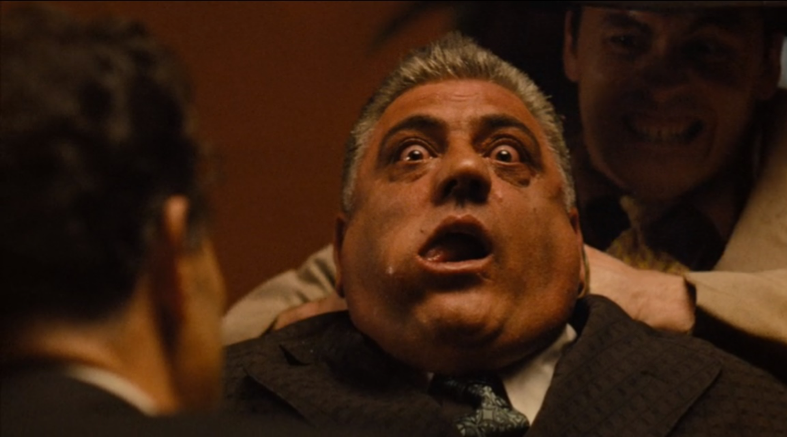
But at that place is no piece of cake escape. Instead of ceasing, Brasi'south strangulation is extended as long as possible. In this hitting, visually repulsive moment, we are forced to endure his expiry in its entirety. Luca'south gasps go softer. His face becomes tinged with a purple, bruised color. His eyes are pushed out of their sockets and become ii vacant bulges as his tongue sticks unnaturally outside his oral fissure. In preproduction, Coppola'southward special effects memo reads, "This is probably the well-nigh difficult effect in the movie." Luca's dying moments here are backed by sufficient inquiry to capture all the unpleasant physiological changes that occur realistically with strangulation. (Annotated Godfather, 76) This scene holds null back. Once the choking Brasi ripens to the complexion of a grape, and his limp figure starts to skid nether the tabular array, we take to accept the imminence of his expiry.
Even so Luca'south fatigued-out suffering and the morbidly jarring violence of this scene are not inserted in the film simply for the sake of violence, just to titillate or transfix the viewer. Brasi's suffering is key to the movie's greater significance, as this short scene marks a monumental turning point within information technology. From his expiry alone, The Godfather forges its overarching conflict and defines the ensuing direction of the plot. It takes i scene to dramatically color Sollozzo and Tattaglia as merciless villains.
The murder of Luca Brasi colors Sollozzo and Tattaglia every bit merciless villains, and seeds feelings of daze, disgust, betrayal, and sadness—out of which emerges the heightened question, "What next?"
The scene seeds, inside the audience, feelings of shock, cloy, betrayal, and sadness—out of which emerges a heightened wonder of 'What next?' Moreover, Luca's eventual expiry does not mean an end to the violence; it is, in fact, the bound starter for information technology. Brasi's death, then, opens onto many forms of loss—the loss of a trusted friend, the loss of peace amidst the Five Families, and all the human being losses that we anticipate volition arrive with the unprecedented storm that is about reach the Corleones.
Jenna Allen ('18) is a Cal undergrad working on her B.A. in English language Literature.
Works Cited
Jenny M. Jones, The Annotated Godfather (New York: Black Domestic dog & Leventhal, 2007).
Men of the Business firm: Modes of Masculinity in The Godfather
By Janani Hariharan
In The Godfather, director Francis Ford Coppola introduces the lead character Michael Corleone in the most curious of ways: well-nigh 13 minutes after the film has begun, Michael walks into his sis's improvident wedding ceremony, wearing a total Marines Corps uniform with a non-Italian-American woman on his arm.
This choice on Michael'south function, and on the part of Coppola, signals how The Godfather — though produced in the early 1970s — is a film that reflects on the mid-1940s, a time when masculinity was being redefined in the wake of the Second World State of war. Historian Corinna Peniston-Bird argues that during the war, "opportunities for contraction, transformation and resistance were limited. Men did non have a choice whether to confirm or reject hegemonic [military] masculinity." Just what happened one time the state of war ended, when men had to utilize their bodies exterior of war? What happened when decorated state of war heroes like Michael had to come home and redefine their manhood without wartime's existing framework?
This problem is tackled in The Godfather through Michael but extends to every homo in his family. The Godfather dramatizes this crisis of masculinity through male characters' interactions with other men. While Vito uses restrained movements to exert influence, Sonny's big, advised, impulsive actions take up space. Michael, meanwhile, takes a page out of both their books, using his intelligence and audacity to command authorization. Insofar as the film equates masculinity with ability, these important male characters in the picture show utilise their bodies in dissimilar ways to secure their patriarchal positions at the head of the family.
***

Vito Corleone controls his movements impeccably, using his body in only the most understated of ways to convey a sense of almighty authorisation over other men. This becomes evident as soon as the movie begins: the beginning time we equally viewers lay eyes on whatsoever function of Vito, the camera faces Bonasera from over Vito's shoulder. Bonasera, sitting on the other side of Vito'due south desk, begins to sob at the plight of his daughter's suffering. Nosotros see non a commanding body towering over Bonasera but an out-of-focus hand in the foreground, gesturing to a capo to bring Bonasera a drinkable in consolation, which he gratefully accepts.

With just the use of one out-of-focus hand, the film situates Vito's potency in methodical activity and institutional relevance. His is a masculinity characterized past the deference and obedience of other powerful men — a masculinity that doesn't demand to exert power actively because the institution he has congenital on his own terms does it for him. Presently subsequently the photographic camera cuts to face Vito, we see him petting a minor true cat on his lap as he discusses matters of life or death with Bonasera. The cat, sprawled on his lap, luxuriates in his attending and infuses a playful energy into an otherwise dark and heart-searching room. Past critics accept pointed to the cat equally representative of hidden claws under Vito's subdued façade. To me, however, a subtler detail stands out, especially when Bonasera makes the grave mistake of asking Vito, "How much shall I pay you?" Vito immediately looks up at him from the corner of his eyes, affronted, and stops playing with the true cat. He puts the cat on the tabular array as if to mean serious business, stands up, and calmly confronts Bonasera near his infraction: "Bonasera, Bonasera. What have I washed to make you treat me and so disrespectfully?"

The cat in Vito's hands is a symbol of the judicious way in which he wields power: he plays with the cat and gives information technology what it wants until he decides playtime is over. The Don giveth, and the Don taketh away, and so to speak. These first few scenes illustrate what I would telephone call Vito's calculated gentleness: his trunk linguistic communication is characterized past restraint, which highlights the potency he draws from only beingness the head of the family and being revered and feared by then many.

Of course, Vito's authorization changes later he steps down from his position equally the copo dei capi. Vito becomes more of a family unit man, indulging in wine and time with his grandchildren. In an uncharacteristically tender moment toward the end of the film, we see Vito playing with his grandson in the garden. He presses an orange skin confronting his teeth to scare the child and lets him spray him with a water gun as they run around through the orangish plants.
Poignantly, this is when his body gives out and he passes away. "I spend my life trying non to be careless," Vito had admitted to Michael but moments before the film cuts to the garden scene. You lot would call back that being a Mafioso is more life-threatening than being a grandfather, so it seems particularly biting that during his most unprotected moment in the film, he dies. Vito'southward masculinity and ability rest on the foundation of the institution he has built; when he finally moves without formal restraint, his vulnerability is not allowed to final. Within the scope of being a beingness a don, tenderness — when it's not calculated — becomes weakness.
***

This weakness becomes apparent after an attempt is made on Vito's life by a rival family unit, and the film offers upward his oldest son, Sonny, as a solution to this newly created vacuum of power. But if Vito spends his life trying not to be devil-may-care, Sonny is a homo who spends his life doing the consummate contrary. Brash and impulsive, Sonny wields his body in intensely physical, violent ways; he asserts a hypermasculinity in relation to those effectually him, men and women alike. During Connie's wedding, Sonny flirts with the maid of honor equally his wife Sandra sits at another table. Soon after, we come across Sonny and the bridesmaid in a bath having rough sex upward against a door. Tom Hagen goes looking for him at Vito'southward asking and knocks on the door. "Sonny, are you in there? … the former man wants to come across you," Tom calls from the outside. "Yeah, one minute," Sonny responds, earlier continuing with his pursuit.
If Vito maintains his masculinity through restraint in order to keep the family unit in power, Sonny asserts his through reckless self-indulgence, prioritizing his own needs and desires over those of the family. A particularly telling moment afterward on in the flick illustrates this difference of worldview between father and son. In a coming together nearly the possible growth of the drug merchandise in their expanse, Vito and Sonny learn from a fellow Mafioso that the Tattaglia family unit would be willing to work together to ensure the Corleone family's security. Sonny, immediately interested, butts into the conversation: "You're telling me that the Tattaglias would guarantee our invest—" But Vito does non allow him to finish. "Wait a infinitesimal," Vito tells Sonny, as he looks back at him, irked and disappointed, and proceeds to elegantly divert the chat away from the infraction.

After the meeting ends, Vito tells Sonny to stay backside and reproaches him: "Santino … what's the matter with yous? I think your brain is going soft from all that comedy you're playing with that immature girl. Never tell anybody outside the family what you're thinking again." Sonny, like a ill-behaved child who refuses to mind, looks away and rolls his optics at the scolding. Through this interaction, we run into that Sonny's intelligence and competence as a man and a leader is frustrated by his impulsive desire to disobey the configuration of norms and codes as ready by Vito. His refusal to practice restraint and judiciousness in making decisions upsets Vito, and it is ultimately what leads to his downfall.

All the same Sonny loves his family as fiercely as he indulges in his ain whims and fancies — and as the film progresses, these ii passions create a recipe for disaster. Sonny finds his sister Connie with bruises all over her face, ostensibly because she had been abused by her husband Carlo. "Sonny, delight don't do anything. Please don't exercise anything," Connie pleads, recognizing where Sonny's mind would immediately become. "What am I going to practise? Make that baby an orphan earlier he'south born?" Sonny says as he holds her. In the scene that immediately follows, Sonny jumps out of a car with a baseball bat and chases Carlo down. "If you touch my sister again, I'll impale you," Sonny says through gritted teeth, subsequently having beaten him to a lurid.

While it may seem like a justified retribution — a black center for a black eye — it is this hotheadedness that triggers Sonny's downfall. After another fierce atmospherics between Connie and Carlo, Sonny receives a call from Connie. "You wait right there," he says, and jumps into a car and drives off angrily, despite pleas from Tom to stop or at to the lowest degree slow downward. "Get after him, go on!" Tom tells other members of the family, and they go into a car to follow him. Sonny ultimately drives off to his demise as he is ambushed at a tollbooth by machine gunfire, in a set-up orchestrated by enemies of the family with the help of Carlo.
If Sonny had not been and then quick to attack Carlo afterward the showtime incident, he may have never made an enemy out of Carlo and would not have met such a gruesome and sudden death. Minutes after the assailants drive away, Tom's men make it at the scene just to find Sonny lying dead in the middle of the road. At the very least, if Sonny had waited for others to join him before he collection away to face up Carlo, he would have had some form of reinforcement during the ambush. Unlike Vito, Sonny is neither calculated nor gentle, relying on brutish strength and carnal instinct to use his body and exert ability. His masculinity ultimately proves to be an unfeasible solution to the vacuum of power in the wake of Vito's set on.
***

Sonny's decease leaves his younger brother, Michael, as the most viable option to take the helm of the Corleone family. If Vito's placidity authority and Sonny'south devil-may-care impulsiveness occupy opposite ends of the spectrum of masculinity presented in the film, Michael'southward masculinity lies squarely in the middle. He is intelligent and collected only unforgiving: he has the tact of his father and the audacity of his brother. A telling difference between Sonny's and Michael's body linguistic communication is highlighted during the ii brothers' meeting with Clemenza, Tom, and Tessio, as the five discuss how to handle Sollozzo's asking to discuss a truce. Sonny unsurprisingly raises his voice at the idea of Sollozzo's proposition, pacing the room aggressively and yelling at those who suggest hearing Sollozzo out. "No more than meetings, no more discussions, no more Sollozzo tricks," Sonny yells, towering over Tom. "Do me a favor, Tom, no more advice on how to patch things up. Only help me win." Michael, on the other manus, sits stoically on a costly chair, watching the scene unfold. After a cursory moment of silence, Michael enters into the chat. "We can't wait," he says calmly, remaining seated. "I don't intendance what Sollozzo says almost a bargain, he'due south going to kill Pop. That's information technology."

Interestingly, Sonny and Michael want the same thing: they both think information technology'south wiser to strike now rather than requite Sollozzo the benefit of the doubt. This is indicative of their potential to both be sound leaders. All the same, what Sonny articulates via artless aggression, Michael expresses in a methodical programme of action. "They want to have a meeting with me, correct? … Let'south set the meeting," Michael says, as he goes on to detail how they volition orchestrate the ambush and dodge any possible retaliation.
We might encounter both Vito and Michael every bit self-fabricated men — or cocky-made Dons — though they take different routes to that same destination. While Vito built the institution of the Corleone family unit from the basis-up, Michael comes of age over the course of the film and makes himself into a man by virtue of avenging an attempt on his father's life. We later run across that Michael successfully carries out the plan for the Corleone family, unflinchingly putting bullets in Sollozzo's and Helm McCluskey's heads and ending the threat to this father'south life. Insofar as Vito possesses a calculated gentleness and Sonny does not, Michael learns from their shortcomings to realize a calculated ruthlessness. He is a homo who does not strike unless it is admittedly necessary — only does not hesitate to get his hands dirty when he must.

Michael'south newfound, calculated ruthlessness is powerfully evoked in the movie'south bloody climax, in which the camera cuts between the baptism of his godson and the assassinations of his rivals. But Michael's metamorphosis is even more strikingly dramatized in a scene before long after, when Michael confronts Carlo about his complicity in Sonny'south murder. "Sit down," he tells Carlo, every bit he pulls upwardly a chair and takes a seat next to him. He pats Carlo on the shoulder and calmly reassures him: "Don't be afraid. … Do you remember I'd make my sister a widow?" Michael tells Carlo that he will take to leave for Las Vegas and hands him a plane ticket. "Only don't tell me you're innocent because it insults my intelligence. … At present, who approached y'all?" Michael asks. When Carlo finally admits to his interest, Michael directs him to a car that is supposed to have him to an airdrome. Clemenza, sitting in the backseat, garrotes Carlo to his death, equally Michael watches from the outside.

For all the talk that we hear of Vito "taking intendance of business" toward the starting time of the moving picture, we never once encounter him personally enact violence or be in the vicinity of information technology. Michael, on the other hand, both tactfully extracts a confession and also watches his brother-in-law lose his life at his ain order, without and then much as a flinch. The film establishes Michael's masculinity relationally through the men that came before him: he learns from his begetter's distaste for violence and his brother'southward carelessness to become a true, successful copo dei capi of the Corlene family.
Michael's consolidation of power proves to be a plumbing fixtures stop to the first installment of The Godfather trilogy, which is primarily interested in charting the jostle for power between and inside families to institute a new socio-political hierarchy inside the organized law-breaking circuit in mid-1940s America. In the postal service-war context, men grappled with how to limited their masculinity and assert their dominance exterior the battlefield.
The picture encapsulates this struggle past moving through two different modes of masculinity — through Vito and Sonny — before settling on the simply viable option in Michael, whose calculated ruthlessness secures the survival and prosperity of the family unit. The other Dons take been vanquished, and there are no other characters inside the family who might take its captain: the film underscores how Fredo's feebleness and lack of intelligence and Tom's non-Sicilian heritage effectively take them out of consideration for the leadership of the family unit, while the women of the flick are close out of that form of power entirely. Michael stands alone, unchallenged — his character having "successfully" resolved the film'due south complex exploration of the human relationship between gender and ability in the post-war era.
Janani Hariharan (Cal '18) is a senior studying Business Assistants and English language. She may accept been much likewise young when she first watched The Godfather twelve years ago, but she is using this project to help her recover as she continues to explore the implications of gender and its performance in her favorite works.
Piece of work Cited
Linsey Robb and Juliette Pattinson, Men, Masculinities and Male Culture in the Second Earth War (New York: Palgrave Macmillan, 2018).
Popular, Wink, Bang: Color Accents in The Godfather
By Katerina Marovich
The Godfather is a sensually ingenious picture: it lulls its viewers into a dream state with scenes of comfortable warmth, then shocks united states awake through punchy pops of drama and activity. This rhythm is developed, in no small-scale function, through Francis Ford Coppola's distinct and painterly use of colour. The visual scenes of the moving-picture show—brushed with broad washes of color, while featuring abrupt points of accent—requite us many clues and guides into the powerful world of Don Corleone and his "family concern." There is an overwhelming sense of warmth to what we meet onscreen: the general palette holds soft tones of orangish, sienna, and mahogany—colors that draw in the viewer and make them feel like 1 of the family unit, cozily perched in the Don's snug office or falling in love with Apollonia alongside Michael in Sicily. Yet it's the accents—the colors that accentuate and 'pop'—that bulldoze the near interest in each scene and offering the truest signs of activeness and significant.
To empathise these meticulous placements and punches of color, permit usa offset delve into the most iconic example: Vito Corleone'due south cerise rose in the opening scene.

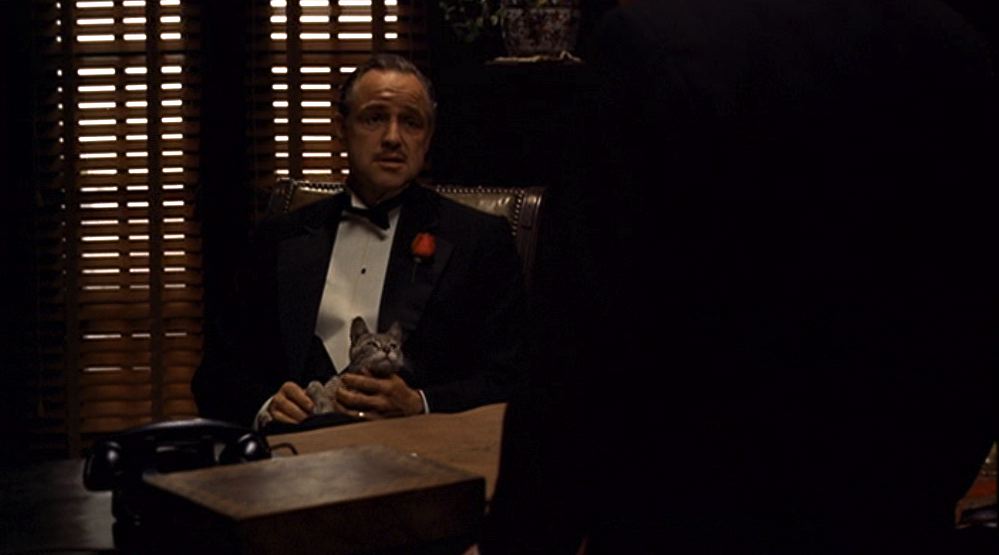
Nosotros are start introduced to Don Corleone through this vivid image of him in his tuxedo, in the nighttime room, with the brilliant red rose sported on his lapel. Our middle is immediately drawn to this gleaming source of color, as this reddish rose promptly becomes an epitome carried through The Godfather's iconography in and out of the flick itself.

The rose, with its splash of color, is featured prominently in the posters and marketing for the flick. Yet what does this red rose represent? Most manifestly it is the symbol associated with honey and romance. Placed over the Don's left breast, or over his eye, information technology may represent passion or foretell the spilling of blood. In retrospect we can encounter how information technology foreshadows the circumstances of the Don's downfall (how his love of his family unit takes his business into a crisis) also as his ultimately peaceful end (his decease of a heart attack). All of this is pulled through this pinhole image of the red rose confronting all the darkness surrounding him.
Fifty-fifty equally the scene pulls abroad, the red rose is at the center of the frame, pin-pricking the Don's center with incredible precision. Although the remainder of the frame is set up in the soft warm oranges and browns that nosotros abound accustomed to, this red-hot image on the breast of the Don presses all of his warmth and his love of family into a single center. From some other angle, we might say that the unabridged family center is found within Vito—or that the passion and love and emphasis on family unit all derive from Vito Corleone'south ain vision.

This image of the ruddy rose returns, in a more minor key, at the Don's funeral, as the mafiosos each leave a ruby rose on the grave at his burial. Barzini and the other mafiosos nonchalantly lob the roses onto the grave of the late Don, without any semblance of emotion or grace. The passion and dearest that these roses represent to the Don die and are left alongside Vito Corleone, and we are left with the dark mercilessness of Michael to replace him. The powerful passion that held the family unit center is no longer at the center as it was in the opening scene of the movie, but now tossed rather unceremoniously to the grave.
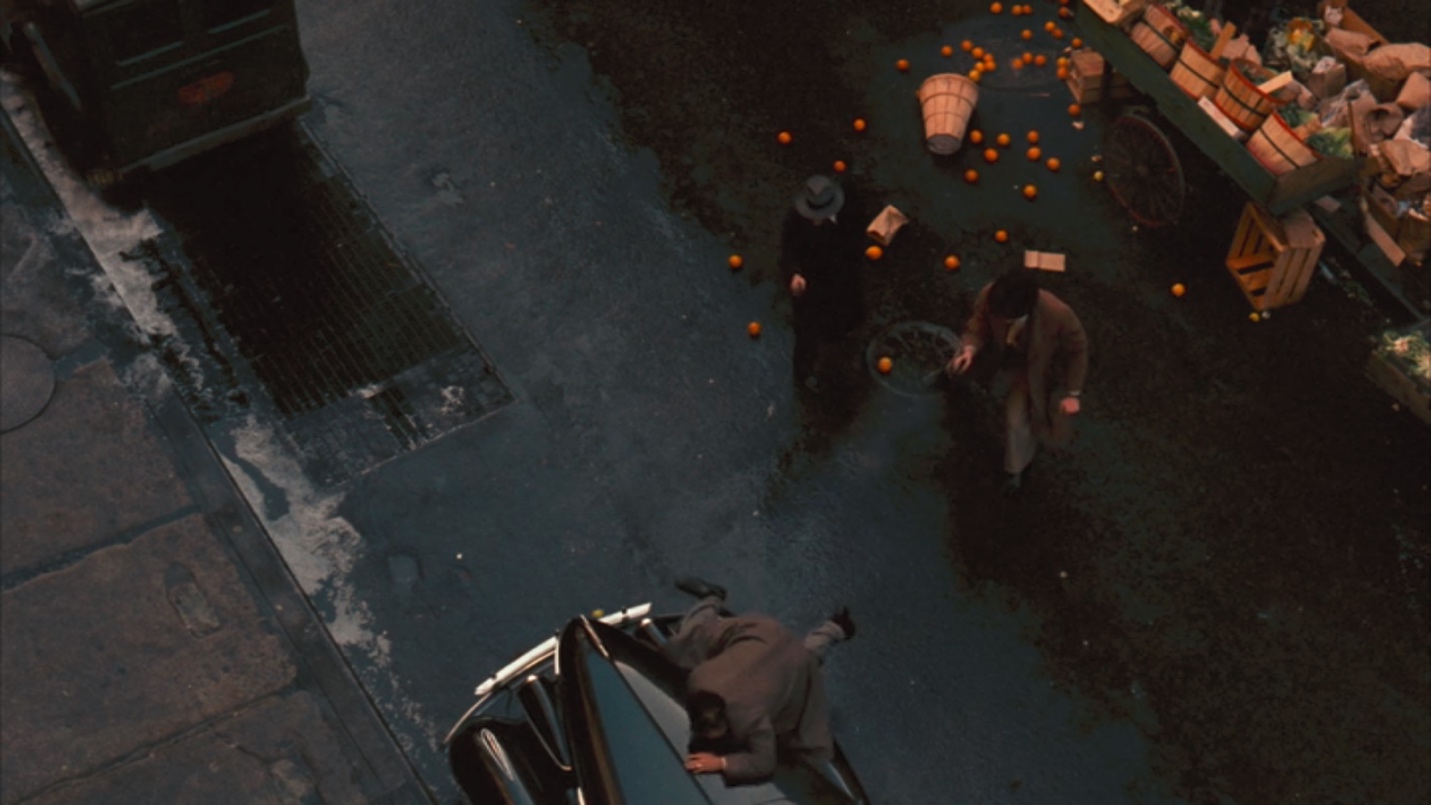
However, the bright ruby-red rose is non the only warm accent that punctuates drastic images within the film and creates an indelible moment in the moving-picture show. Another cute example is seen when Vito Corleone goes to the marketplace and is later shot by men sent by Sollozzo, "The Turk."


This single image epitomizes the entire scene, which unfolds in an incredibly beautiful and aesthetic way. Notice the composition of the colors in this frame, the darkness and coolness that envelops nigh of the frame in the bottom left-manus side. Yet the pop of warmth and orange draws the eye to the upper correct-hand corner. The shot is at a dizzying bending upwardly and away: the photographic camera is elevated to a birds-eye view that offers both an objective and an artfully tasteful representation of the moment. The angle disorients the viewer, pulling the emotion out of the moment directly, and viewing the sequence equally a 'whole motion-picture show.' The image recalls the genre of American realist painting—for example, Edward Hopper's New York Picture show.
A genre entirely true to the subject area affair that attempts to describe the moment in a scrupulous way that likewise appeals to the senses. In Coppola'due south American Realism, the oranges that spill onto the street speak to the life existence drained from Vito as he is shot in the street—a metaphor for the blood existence spilled—and stand for the disarray of the family too. The Don descends from the warmth and falls into the absurd darkness of the street on both a physical and metaphorical level.

After this moment, the last instance of a warm color we see is once again the red accent of dripping claret from Vito himself. He is then drowned in a wash of absurd tones and night colors as we lose sight of this bright flash of scarlet. Nosotros are left not knowing whether the Don is alive or expressionless, as the darkness of the scene envelops his entire person and pulls away our knowledge of his life. This is a distinct turn in the picture as well, every bit the power turns from Vito Corleone to his sons, and there is an incredibly night shift in the manner the business organisation is run. The movie drifts into this darkness just as Vito Corleone slips to the darkened pavement in this scene.
To fully understand the bear upon of these pops of color surrounding Vito Corleone and his way of managing the family concern, we might contrast them with the terminal scene with Michael taking over for Vito in the office in which it all began.

In this moment, the hues of the warm browns and oranges are dampened, deepened, almost entirely muted with the exception of Michael's stark white shirt at the centre. As opposed to this whiteness presenting purity, it tin instead be seen as a beacon of harsh low-cal. The source of all attending, much less comforting and aesthetically sympathetic than Vito's romantic cherry rose. We are left with the cooled world-tones of Michael rather than the warmth of reds and oranges associated with the late Don, and forebodingly terminate the moving picture in deep darkness. All the warmth of the family unit business that the viewer has come to associate with the Corleone family unit throughout the flick has been entirely sucked out. Nada remains merely Michael's stark, brisk coolness.
Katerina Marovich (Cal '18) is a senior English major from Northern California planning on taking her English degree into the publishing field.
The Story Backside This Site: Or, Can a Lecture Course Besides Be a Publication Workshop?
By Scott Saul
This website exists because, in the fall of 2017, I read the post-obit sentences from Cathy Davidson'southThe New Education, a book-length manifesto for rethinking how universities teach their students: "Students practice not do particularly well writing papers for the sake of writing papers," Davidson suggests, 
Davidson's bespeak aligned with my own recent experience as a instructor, and specifically equally a teacher of writing. I'd started to feel a sense of diminishing returns when I but asked students to produce what has long been the "industry standard" in English language departments: the 5-page essay of close analysis. At its all-time, this assignment allowed students to smoothen new lite on a formerly obscure corner of a text (and prove to themselves that they were ready for the rigors of graduate report in the discipline). At its worst, this assignment felt like make-piece of work to students — something written only for the eyes of the person grading their writing. It was inconceivable, to many, that anyone else might exist interested in their thoughts on, say, Emily Dickinson or Robert Louis Stevenson or Toni Morrison. They were writing an essay considering they had to, for someone who was reading it considering he had to—not exactly a recipe for the product of deathless prose.
So in 2016-17, I taught two new courses for me: a creative nonfiction workshop in Cal'south English Section and an honors research seminar on the 1970s Bay Surface area for Cal's American Studies Program. In both classes, the goal for the students was to create something that, after multiple revisions, would be published online — something written "for the world". In the creative nonfiction workshop, which had twelve students, the platform was a Medium site called The Annex; individual pieces came to attract somewhere betwixt a hundred and 9,000 views. In the research workshop, which had only eleven students, the class collaborated to create a digital history projection,The Berkeley Revolution,which, upon its launch in July 2017, received favorable notice beyond the web and has drawn a steady stream of nearly fifty unique visitors a day.
I had experienced some success in turning undergrad seminars into publication workshops, but readingThe New Educationmade me wonder: would it exist possible to exercise something like with a lecture course?
I had experienced some success, then, in turning undergrad seminars into publication workshops, simply readingThe New Teachingmade me wonder: would it exist possible to practise something like with a lecture course, and one not specifically oriented to writing? In the spring of 2018, I was set to teach a "Literature and History" lecture course on the 1970s. I decided to enlist the forty-plus students in the class in a writing experiment, and to brand the course's reader—Joshua Anderson, the Cal grad pupil assigned to aid with the grading—my collaborator in the editorial enterprise.

Generating the Assignment: "50 Ways of Looking atThe Godfather"
Good news for those who might wish to adapt this projection for their ain purposes simply are leery of annihilation that smacks of technophilia: the writing consignment that generated this site bore great resemblance to the ane I'd used in previous versions of my course—a "close passage analysis" assignment. (In fact, the model essay I gave students, which appears here as "Inhale/Exhale: Cigarettes and the Power of Michael Corleone," had been written for the Autumn 2016 version of the class.) The frisson, such as it was, came from the consignment's framing. From the start, students knew that they were working together on a larger projection— "Fifty Ways of Looking atThe Godfather: A Collective Project in Close Motion-picture show Assay"—with their essay only one piece in a larger puzzle. I had chosenThe Godfather as our point of focus because (a) information technology was ballsy, multi-dimensional, and exquisitely crafted, and so could easily exist parsed from fifty-plus different angles; and (b) as an early-1970s artifact, it fell early in the term on the syllabus, then on a applied level we could have 2 months to develop the larger project.
Here's some language from the original assignment:
The Godfather is an intricately crafted moving picture that has little wasted movement to it: fifty-fifty its seemingly minor scenes, and seemingly modest characters, add to its textured portrait of the Corleone family and its 'family business.'
Through this assignment, we will throw ourselves collectively into the projection of figuring out how the many different pieces of The Godfather add up. Each one of you will take on a unlike aspect of the film and write an essay that—if appropriate—blends interpretation and some inquiry into the movie through reference to the two major sources on its making, The Annotated Godfather and The Godfather Notebook.
Your essay topics will describe from the list of topics posted in a google doctor, though you are free to advise additional topics of involvement.
Because the essays volition be published digitally, you are asked to be aware of the possibilities of the digital format. It is expected that, in your close analysis of the picture show, yous volition stitch in a number of screenshots—or possibly .gifs—every bit y'all dwelling in on key moments in the fabric you've selected to analyze.
You should besides exist aware that yous are writing for a larger audience. Imagine yourself explaining the workings of the picture to a sophisticated but not necessarily expert reader—someone who has watched The Godfather, is aware of the basics of film technique, and wants to understand better the workings of the film. Amy Taubin's book on Taxi Driver might give you an case of the right tone: smart, vivid, curtailed, calorie-free on its toes even when engaging with weighty matters. Try to write something that will be both stimulating and useful to the person reading it.
To ensure that students wrote on distinct topics—I didn't want half the class to write on the baptism/assassination montage, equally captivating as it is—I generated fifty-plus topics and created a google doc so that students could come across the carte du jour of options and claim a topic. Effectually seven of the forty-five students took the initiative to devise their own topics (for case, the essays here on alcohol, trunk linguistic communication, and colour accents). I encouraged students with special areas of expertise to tackle topics that would depict on that expertise. A student with a longstanding interest in fashion took on costume pattern; a pupil who edits Cal's music mag, the film's score.

A Process of Writing and Revision: From 45 Rough Drafts to 45 Final Drafts
My strong sense was that my students, as talented equally they were, could write pieces onThe Godfatherthat invited general interest merely if they did what professional writers practice: revise their pieces through a sustained dialogue with editors who could help them tighten their prose and put their finger on what was nigh compelling in it. This meant that these pieces would non exist produced on the usual undergraduate timetable—submission and evaluation within a span of, say, ane or 2 weeks. Rather, in that location would be a six-week recursive process of feedback and revision, with first drafts submitted in mid-March.
This focus on revision created a labor problem, since giving practiced, specific feedback on writing is a labor-intensive endeavor that, every bit far as I know, no app has managed to simulate. I crowd-sourced that labor, in part, by carving out 1 grade day for peer workshops, with each pupil paired up with ane other educatee so that they could get, and give, intensive feedback.
More than significantly, I recruited Kyler Ernst, a talented undergraduate from my fall artistic nonfiction workshop, to help with the fine-grained piece of work of commenting on and line-editing the students' essays. (This rent was supported by Cal'southward Art of Writing Plan, through the good offices of Professor Ramona Naddoff.) Kyler, Joshua and I divvied up the 45 rough drafts between the three of us.
Non long after we dove into reading the students' drafts, nosotros discovered that it made no sense to give the same sort of feedback on every typhoon. Some drafts were exceptionally "drafty"—unfinished, or not well-organized, or notwithstanding in search of a key statement. Others were already polished to a fine degree, and could be line-edited in preparation for inclusion on the site. Still others—the majority—fell in the middle: they were coherent, but needed considerable work so that their promise might be realized.

The students who'd written "drafty" drafts were enjoined to meet with me, Joshua, or Kyler, and asked to turn around a second draft speedily if they wished to have their work under consideration for the last site. The other students (about 3/4 of the class) had their drafts edited through the "Track Changes" function on Microsoft Discussion, and then had several weeks to answer to comments and revise accordingly. Concluding drafts were submitted on April 20, one month after the due date of the first rough draft.
Tough Calls: From 45 Final Drafts to 17 Final Pieces
With these 45 last drafts in hand, Kyler, Joshua and myself met to decide which pieces might become forward and be further line-edited and then as to appear on the site. We were happy to meet how much, in general, the essays had improved: they were more focused, more than sure-footed, and more sensitive in their handling of the details of the film. We were as well aware that time was ticking, that the finish of the semester was almost, and that it was unfeasible for Kyler and myself (Joshua was going to be decorated with the evaluation of the students' accept-home finals) to line-edit more than effectually 15 essays by the end of the term.
Winnowing the pile of essays from 45 to a 3rd of that number was not an easy job. We started by observing that despite our best efforts, some essays had repeated some of the same textile, and we could make some progress past determining, say, which essay had a more than nuanced take on Clemenza and his cannolis. Ultimately, as well, it seemed that the students who focused on technical aspects of The Godfather—its handling of editing, its production or costume design, its photographic camera piece of work—were more than successful at finding a fresh angle on the film. Finally, we put a strong value on the crispness of prose: a tight one thousand-word essay was easier to imagine on the site than a 2000-give-and-take essay, studded with rich insights, that had some soft spots to information technology. Nosotros concluded upward choosing seventeen essays, the large majority of which I took responsibility for line-editing.
Designing the Site and Fine-Tuning Its Design
At this bespeak our story takes a happy turn. The process of creating this site reminded me of my feel seeing an apartment edifice go upward in my neighborhood: for years, there was fiddling discernible progress equally the foundation was laid and the scaffolding erected—and and then, seemingly in the blink of an eye, at that place was a make clean, habitable structure with doors, windows, and all the architectural trimmings. So with this site: after the two months of labor-intensive writing and re-writing, editing and line-editing, the site itself came together swiftly over a few weeks, in the form you now experience.
I was fortunate to have hired the very capable Kristin Jones, a web developer and Germanist who had earlier designed my Berkeley Revolution site, to design the site; Kristin rapidly tailored the Fox WordPress Theme (price: $59) so that it matched what we needed. Kyler—who happily besides had a background in graphic pattern—created the header banner and the footer banner. I inputted the essays and formatted them with images, block quotes, and the like. The process was relatively frictionless.
In retrospect, it seems to me that the most difficult piece of work behind the site involved the function that now is relatively invisible. This was the mental work that my students performed by writing and rewriting their prose, and that I and my swain editors performed through the various tasks of line-editing—hacking away at unnecessary verbiage or making suggestions for how an argument could take on an extra edge. Notably, this is likewise the part of the site that teachers in the humanities tend to be extremely qualified to pull together and pull off.
Some visitors to the site may appreciate that the site is visually attractive too—and I would welcome any such appreciation. But I would underline, for any teachers who balk at creating a public-facing digital project, that the software developers of the world have risen to the challenge of developing hands-customized templates for digital publishing. These teachers should know that orchestrating the design side—the nifty sidebars and widgets, the clean lines and coordinated fonts—has been made piece of cake. As e'er, the prose's the thing.
Scott Saul teaches in Cal's English Department and American Studies Plan. He is the author ofBecoming Richard Pryor (HarperCollins, 2014) and the editor-publisher behind 2 digital history projects,Richard Pryor's Peoria andThe Berkeley Revolution. He welcomes comments at ssaul@berkeley.edu.
Source: https://theseventies.berkeley.edu/godfather/tag/francis-ford-coppola/
0 Response to "According to the Reading the Success of the Godfather Can Be Treated to Coppola's"
Post a Comment